
Stasis is the enemy
How should we fight it?

In the past two weeks a common idea has floated past me a few times, both online and in-person. Today I want to try and connect those dots and amplify that message.
Last week, Noah Smith shared thoughts on the absurdity of de-growth, and how we see it playing out in the UK. The key idea is not that Britain has explicitly adopted a blanket de-growth policy, but something subtler and more pernicious. People in the UK have fought against change successfully for more than a generation, and the resulting stasis has left them far behind their peers.
Change is scary, and ensuring people that the government will prevent change is what I call a “stasis subsidy” — a promise that looks cheap in the present because it incurs no fiscal costs, but creates huge economic costs down the road. The UK is paying those costs now.
Meanwhile, a day earlier Ryan Puzycki wrote a brilliant essay about life in fast-growing Austin, TX.
The Austin metro area leads the state not only in population growth, but in GDP and employment growth, too. Austinites have the highest incomes in Texas, while the rate of poverty has fallen to 9.5%, below both the statewide (13.7%) and national (11.1%) rates. Growth has raised the standard of living in the Austin metro area.
And it’s not just the economic benefits. The greater variety of people has meant the city can cater to a greater variety of interests. Today’s Austin has mosques and synagogues and Sikh gurdwaras, restaurants serving Caribbean and Indian and Vietnamese fare, CrossFit boxes and Barry’s Bootcamps and Lagree studios, music venues playing alt-country and indie rock and classic jazz. And you can still get cheap beer and Tex-Mex.
A few days before I read these articles, I’d had a conversation with Chuck Marohn along this same theme. Chuck stopped nearby on his book tour, and I was able to come see the talk.
At the talk, an audience member has asked Chuck for his thoughts on Community Land Trusts (CLTs). If you haven’t heard, CLTs are recently in the spotlight on the left1 as sort of compromise with the YIMBY goal of building housing broadly.
Given this was an affordable housing talk, I think the audience expected Chuck to speak in favor of CLTs. But he said he was skeptical of them as an affordable housing solution, because as much as the idea seems logical in the short-term, in the long-term it locks in stagnation.
The next day Chuck and I debriefed on the talk. I told him that I thought the word he was looking for was stasis. The main ideas of a CLT is to prevent land from turning over, to resist change. That’s stasis.
But having reflected on this, the point is more nuanced. The mechanism is stasis, and stasis leads to stagnation.
What one generation of progress looks like
Circling back to Noah Smith, in his remarks about de-growth in practice, he linked to an excerpt from Robert Caro on life in the Texas Hill Country. Reading the piece is eye opening, and, frankly, shocking.
Because there was no electricity, there were no electric pumps, and water had to be hauled up—in most cases by the women on the farms and the ranches, because not only the men but the children, as soon as they were old enough to work, had to be out in the fields. The wells in the Hill Country were very deep because of the water table—in many places they had to be about seventy-five feet deep. And every bucket of water had to be hauled up from those deep wells. The Department of Agriculture tells us that the average farm family uses two hundred gallons of water a day. That’s seventy-three thousand gallons, or three hundred tons, a year. And it all had to be lifted by these women, one bucket at a time.
I didn’t know what this meant. They had to show me. Those women would say to me, “You’re a city boy. You don't know how heavy a bucket of water is, do you?” So they would get out their old buckets, and they'd go out to the no-longer-used wells and wrestle off the heavy covers that were always on them to keep out the rats and squirrels, and they’d lower a bucket and fill it with water. Then they’d say, “Now feel how heavy it is.” I would haul it up, and it was heavy. And they’d say, “It was too heavy for me. After a few buckets I couldn't lift the rest with my arms anymore.” They'd show me how they had lifted each bucket of water. They would lean into the rope and throw the whole weight of their bodies into it every time, leaning so far that they were almost horizontal to the ground. And then they’d say, “Do you know how I carried the water?” They would bring out the yokes, which were like cattle yokes, so that they could carry one of the heavy buckets on each side.
Sometimes these women told me something that was so sad I never forgot it. I heard it many times, but I’ll never forget the first woman who said it to me. She was a very old woman who lived on a very remote and isolated ranch—I had to drive hours just to get out there—up in the Hill Country near Burnet. She said, “Do you see how round-shouldered I am?” Well, indeed, I had noticed, without really seeing the significance, that many of these women, who were in their sixties or seventies, were much more stooped and bent than women, even elderly women, in New York. And she said: “I’m round-shouldered from hauling the water. I was round-shouldered like this well before my time, when I was still a young woman. My back got bent from hauling the water, and it got bent while I was still young.” Another woman said to me, “You know, I swore I would never be bent like my mother, and then I got married, and the first time I had to do the wash I knew I was going to look exactly like her by the time I was middle-aged.”
These stories are less than a hundred years old! The Hill Country wasn’t fully electrified until 1948.
In the intervening seventy-six years life has progressed from this...

...to this.
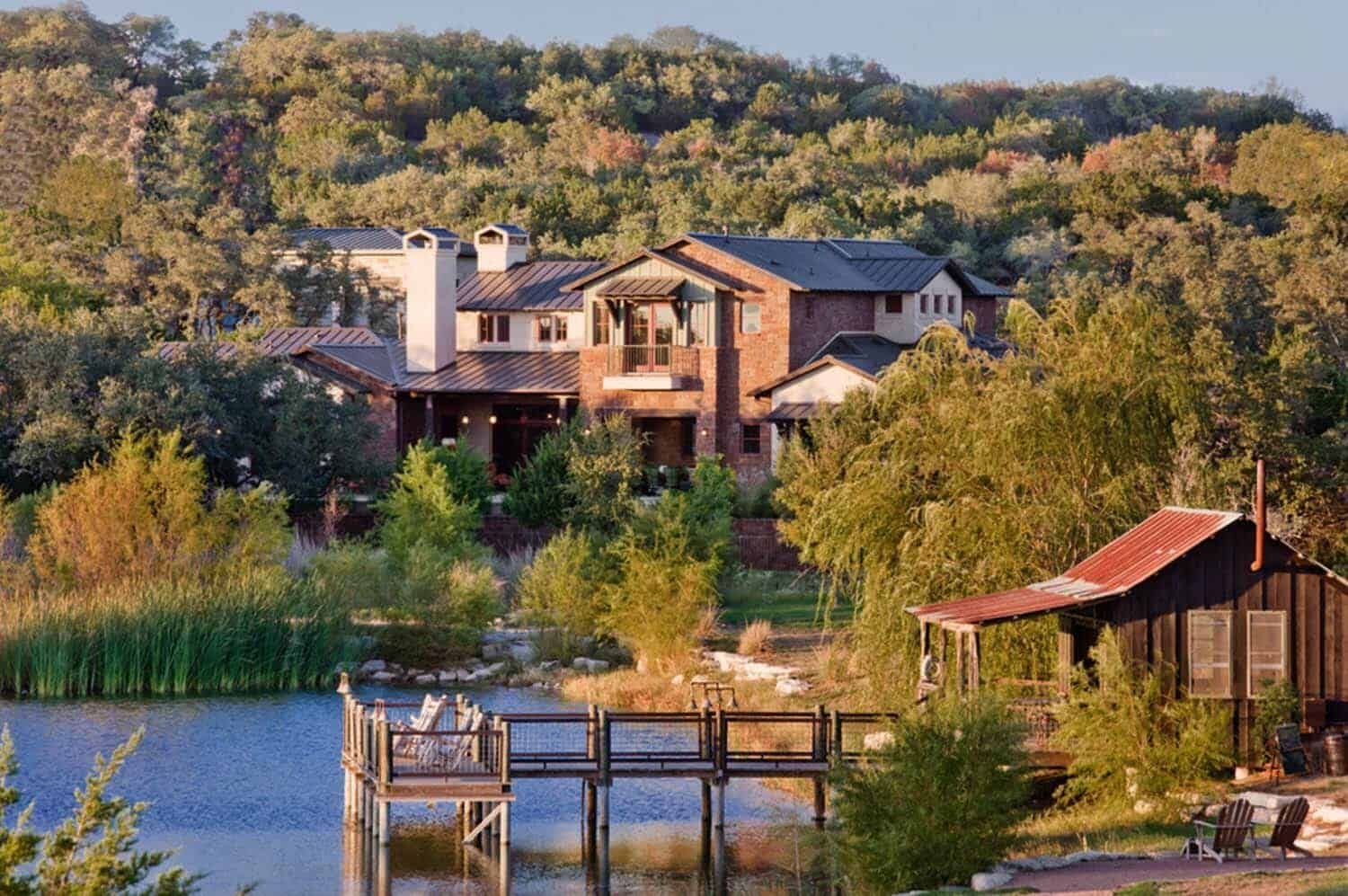
Note the historic shack in the foreground, this history is recent enough that a lot of those are still around. I don’t think regular people comprehend this difference. We live in a fundamentally different universe than our grandparents grew up in.
Now, perhaps this all resonated more for me because I’m from Austin. The woman in the first photo could have been my grandmother. There’s a shack like the second photo left as a “historic marker” in the neighborhood park near my parents house. But even I struggle to get my head around the recency and magnitude of this change.
The material cost of standing still
I don’t think most Americans realize that we’re already well on our way to following in the footsteps of the UK. As our state capacity has declined, and NIMBYism has strangled our economy, American progress is increasingly limited to the heartland areas (especially Texas) that still allow development.
In the past 20 years, China has built a national high speed rail network, from scratch, of a similar size and scale to the US Interstate Highway system. The network moves passengers more than twice as fast as driving, using less land, and without any traffic jams or air pollution. But if you prefer driving, China is rapidly overtaking western carmakers with vehicles (especially EVs) that are higher quality and cheaper than we know how to make.
Even among the relatively sluggish European countries, we can see examples of progress that seem unimaginable in the contemporary US. Over the past 50 years, the Netherlands rebuilt its national road infrastructure to be safe for walking and cycling; now its children and elderly can independently travel throughout the country, and everyone can enjoy the recreation and quality of life that active transportation provides. Meanwhile, in Norway they built the world’s longest tunnel, 15.2 miles, in five years, for about $234 million dollars (adjusted for inflation); in America it took us ten years and $4,450 million dollars to build 1.8 miles of subway tunnel.2
A word of caution
Given the material harm that comes from the “stasis subsidy,” we have to pause and ask, why is the political power of the stasis faction so strong? Why is it that many people don’t want to let anything in the built environment change?
I think it’s because, just as we’re all a mere generation or two removed from what we’d now consider abject poverty, we’re also within living memory of a tremendous collective trauma.
The last great exercise of state capacity in the US was the work of the high-modernists to convert the country to their vision of a car-centric culture. As the Interstate Highways were built, they smashed straight through our cities, instead of going around them (as President Eisenhower had intended). This resulted in neighborhoods all over the country cut in half and ruined by noise and traffic.
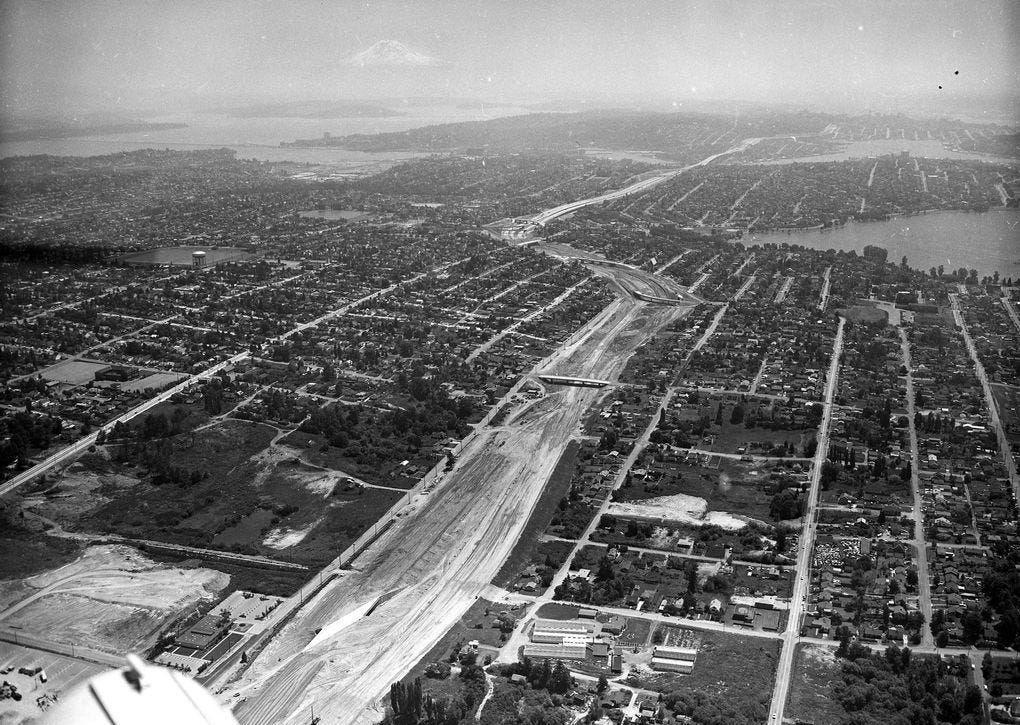
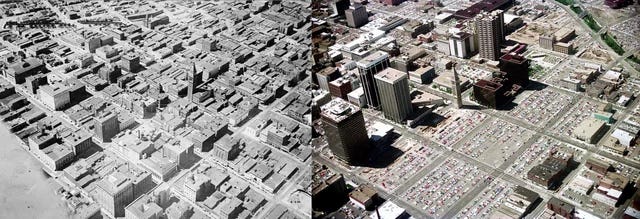
Along with this came a wave of “urban renewal,” resulting in huge swathes of cities being demolished and replaced with housing projects or surface parking lots.
My friend Ian Rasmussen once said that growth in cities is like a party. In a good party, every guest brings plenty food and drink with them, and the more people join the more fun it is for everyone. In a bad party, guests show up empty handed, soon there’s nothing to eat or drink, and the party is a bust. In the pre-war era, new growth meant new shops, restaurants, new churches and schools, new parks and playgrounds. But in the post-war era, new growth meant tearing things down to widen roads, and ever more traffic. Thanks to the geometry problem3, life is a bad party now.
I think this has been true. I also don’t think it’s an excuse. Our cities have to be able to adapt and change over time to be alive.
But it’s worth understanding that radical change has consequences, and it’s likely that the culture of stasis we find ourselves stuck in today is in some measure a backlash to destructive change that happened (in the name of progress!) in the recent past.
The path forward
For YIMBYs and members of the broader abundance movement, we have to remember that stasis is the enemy we’re fighting. Underneath the zoning, the endless NEPA reviews, and the vetocracy at large, stasis is the common root. To win, we have to do three things:
First, we need to be careful not to accidentally bundle in new sources of stasis with our solutions to stasis problems. It’s why Chuck and I are skeptical of CLTs, and why Strong Towns is a bit more cautious about state-level preemption than the broader YIMBY movement -- it’s usually easier to change local laws than state laws, so we have to be thoughtful about giving states a bigger role in land use. We don’t want short-term wins to unintentionally make future policy change even harder.
Second, we need to bias toward incrementalism. No neighborhood can be exempt from change, but no neighborhood should experience sudden, radical change. Radical change usually means unintended consequences, and often inspires backlash. Incremental change is more likely to be inclusive and positive sum.
Lastly, as advocates, we have to cast a positive vision. Broad, inclusive progress is exciting! There’s something deep inside us all, some core part of our human spirit that yearns to make things better. As Americans in particular, the chance to build a better future is what has drawn all of us from all over the world to come together here. That’s the real American dream. So let’s tap into that American spirit, and focus on how we can make things better together.
More serendipity: Diana Lind just wrote her summary of the left-wing view of Community Land Trusts last week. To avoid this digression in the middle of an already long piece, I’ll leave it here. From her piece, summarizing the left-wing appeal of CLTs:
Increasingly shared equity models where wealth is captured and recirculated among locals, such as community land trusts and neighborhood investment trusts, are positioned as the way to address the adverse effects of capitalism.
I have to point out, this “us vs. them” exclusionary mindset sincerely offends me. As nice as the intentions behind a community land trust sound, the end result will be that an unelected set of locals gets to decide who is “us” and who is “them,” and use their control of the land to ensure that only “we” get access to it and “they” are kept out. Which is exactly like the NIMBYs who show up and spout their bigotry at city hall meetings all over the country. They’ve done a great job ensuring that wealth is captured and recirculated among the locals -- whoever already owns a house in the neighborhood. That zero-sum thinking is how we got exclusionary zoning and housing scarcity in the first place. We can’t defeat the great evil they’ve wrought on our country by doing the same evil thing that they did.
The comparison of a rural project to an urban one is a bit unfair, but should it really be 160x as much per mile? (2,472M per mile in NYC vs 15.4M per mile in Norway).
I’ve referenced the geometry problem before, but at some point I probably need to write a deep dive. In short, the problem is that cars take up much more space than humans. This means that if you have any destination that a lot of humans want to go, or any route that a lot of humans want to travel, if they all try to go in cars, it’s physically very hard to make this work; and even when we do pull it off, nobody much cares for the result.
According to Sonia Hirt, the UK has no building by-right, so anti-development has a structural advantage even compared to regulations on local development in the US. The longer these rules stay in place, the more culture entrenches the legal structure.
What's attractive about a CLT strategy is constraints on land speculation, since, I think you would agree, that land speculation is a problem, even in unzoned Houston. Land speculators are the adversaries of developers and consumers, and clearly they have the upper hand.
Great read