

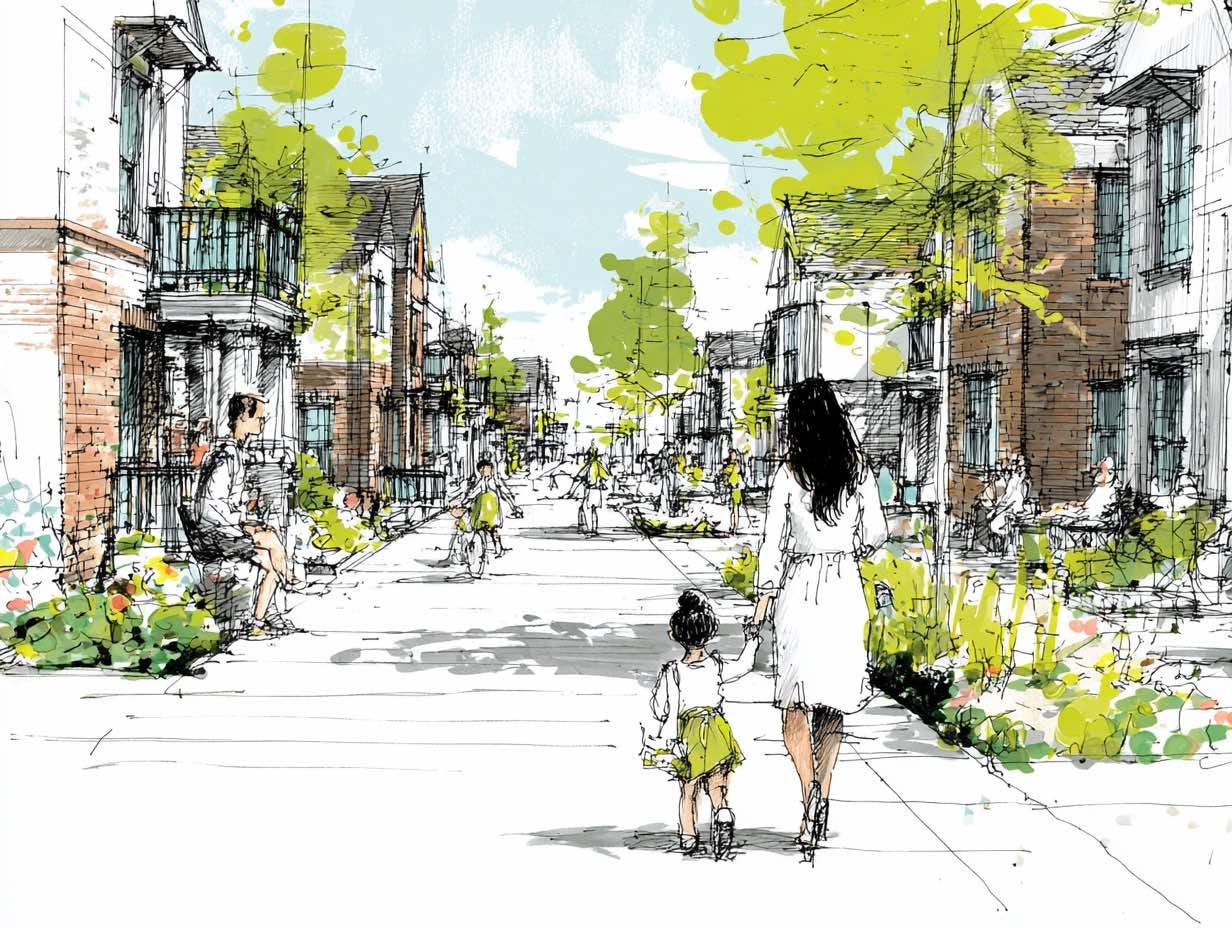
Today I want to share an observation as a seed for future posts. The thought is simply this: Americans don’t have a shared understanding of what “City Life” is.
Since we met in our early 20s, my wife and I have always lived “in the city.” The cities we lived in were quite different, with Houston on one end of the spectrum, San Francisco on the other, and others in between. But, in each place, the locals would have agreed that we lived “in the city,” and we and our neighbors would have called the experience “city life.”
My friends and neighbors in Montrose (an inner neighborhood of Houston) had more in common with, and lived more like, my friends in NoPa (an inner neighborhood of San Francisco), than the people in Katy or Sugarland. Similarly, the people I knew from Fremont and Campbell had more in common with the people of Katy and Sugarland than they did with the people of NoPa or Montrose. The big difference between the San Francisco Bay Area and the Houston area is that SF has dozens of “city” neighborhoods, and Houston has only a small handful. But in both places, a small minority of the land area is home to “city life,” and the large majority is suburban.
In America, there’s a fundamental divide. You either live City Life, or you don’t. More importantly, you either have lived City Life, or you haven’t. And the majority of Americans haven’t.1
Now, I’m identifying myself as a “city” person here, so I want to be clear: there’s nothing wrong with being a suburban or rural American. My goal is neither to criticize anyone’s preferences, nor to promote my own.
This may all seem banal, and I suppose it is. But I find that it underpins a lot of the conflicts we have in the country around issues of housing, transportation, and land use. It’s a cultural divide, and this cultural divide is enormous.
I know this divide is enormous because I experience it all the time, and so do all the “city” people I’ve known.
This plays out in conversations with other people. Suppose you meet someone at a local event, it’s very common to ask where the other person lives.2
Suburban people will say the name of their municipality, the suburb they live in. City people will say the name of their neighborhood.
In the Denver Metro area, a suburbanite would say “We live in Arvada,” or “Aurora,” or “Littleton,” or some other municipality. A city person would say “Cap Hill,” or “West Highlands,” or “Baker.”
As a city person, if you go first, you will find out immediately if the other person is a suburbanite because they won’t know where that is. But, and this is important, there are many city people who currently live in the suburbs, and you will find this out too.
If you are talking to a suburbanite, the conversation goes:
“I live in Park Hill.”
“Oh, uh, where’s that?”
“In Denver, kind of between City Park and Stapleton.”
“Oh is that, like, by the airport?”
“Oh, no not that far. It’s near the zoo.”
“Oh, that’s nice. I love the zoo.”
If you are talking to a city person, the conversation goes like this:
“I live in Park Hill.”
“Oh nice, do you go to Honey Hill a lot? I love that place.”
If you are talking to a city person who no longer lives in the city, the conversation goes:
“I live in Park Hill.”
“Oh, I love Park Hill. We’re in Westminster now, but I used to live in Congress Park.”
“Oh, that’s great, I love Congress Park.”
“Yeah, we miss it. But you know, we needed more space, and we just couldn’t afford it anymore.”
“I know, it’s hard. But Westminster’s nice, y’all have that new Alamo Drafthouse, right?”
“Yeah, it’s not bad, I love our house.”
There’s another conversation we’ve had a few dozen times. Imagine a contractor we’ve hired to do something on our house.
“I’m surprised you live downtown with kids!”
“What do you mean downtown? This isn’t downtown…”
“Oh, this is all downtown to me. Don’t you get a lot of problems? You know, with crime and everything.”
“No, actually, this neighborhood is really safe, we’ve never had a problem.”
“Oh, really? Still, I just don’t know how you deal with all the traffic and no parking.”
“It’s really not a problem. I don’t drive that much, and there’s never traffic anywhere I’m going.”
This kind of thing plays out in any number of variations.
For many years after my wife and I were married, our extended family members would assure us that living “downtown” was probably fun while we were “young” but that we’d want to move out to the suburbs once we had kids. As readers of this newsletter know, we intensely feel the opposite, that we want to live in a city neighborhood especially for the benefit of our kids via the added freedom and independence they experience.
I could give dozens more examples like this, but I think this is enough to illustrate my point.
What we’re talking about here are two different cultures, with “city” culture in America being very much a minority culture. We code-switch when we’re around most people. When we meet new people, we carefully feel out whether they’re part of our culture, and we’re careful with what we talk about, to avoid awkward or annoying conversations that we’ve had dozens of times and don’t need to have again.
That cultural divide reflects a huge difference in lived experience. And like other cultural and experiential things, it’s very hard to talk about, and easy to offend people when you do.
This plays out is in conversations with suburban friends or family. As an example, they might ask a city person why they live in the city. And the city person would probably answer by describing things they like about city life:
“We really like the walkability. There’s a coffee shop on the corner, and some restaurants in the neighborhood that we like. We walk to church on Sundays. It’s so convenient, and close to so many things to do. And it’s very social. We just really like it.”
And I know from experience that the suburban person on the other end of this is likely to bristle.
“Yes, well, I have a Starbucks five minutes down the road, and a big shopping center ten minutes away with an HEB+, which is way better than the little stores you have. And our church is fifteen minutes from our house, and I’m in a pickleball club, and all my friends live nearby. And my house is bigger and newer than yours and cost less, so I win.”
And this is just two people completely talking past each other. It’s true that the businesses and activities that exist in the city also exist in the suburbs. And it’s true that you can live in the suburbs and have a vibrant social life. So if you are just listing things that you like, this will not make sense. And as a city person, you cannot make it make sense because we don’t have words sufficient to convey the cultural experience of living inside of an urban fabric where all the parts of your life, including your home, are part of a larger whole, that you belong to, and are immersed in every time you step outside. If you have never had that lived experience, you don’t have any frame of reference to know what that means.
The one thing people tend to land on is “walkability,” because it’s the closest thing we have to a concrete concept that is always present in all places that have “City Life” and rarely present elsewhere. But even that is fading, as more suburban developments try to offer “walkability,” which manifests as wider sidewalks, or parks with “trails”, or open-air shopping centers. I’ve had suburbanite family members show me things like this and say they are “walkable,” and I can only shrug because, no, that’s not what “walkable” means to me, but there’s no point debating that because we have no shared frame of reference to understand each other.
Lastly, this is a weird gap, because the majority suburban and rural American culture is strangely blind to it.
I am a man. I know that I am not a woman. I know that I do not know what it is like to be a woman. And I would never presume to tell a woman what that’s like!
The difference between true city life and normal American suburban life is that stark. But that does not stop majority-culture suburban Americans from telling me at length what cities are like and why I’m wrong to like them etc. etc.
One last metaphor. I did my undergrad at Texas A&M. A&M is famously concerned with tradition, and has a distinct culture that some love and many don’t. Aggies have a saying, probably not unique to us, but we use it quite a lot. “From the outside looking in, you can’t understand it, and from the inside looking out, you can’t explain it.”
That is City Life in America.
A postscript: You’ll note that I didn’t even try to define City Life it in this post, and I hope you’ll understand the reason by this point. But I think about this quite a lot. I think there may be a way to quantify and describe the difference, for people who genuinely want to understand, but I’ll save that for a future post.
I used Claude just to get a ballpark estimate for this, and it came back with an estimate that 7-10% of Americans live in walkable, pre-war neighborhoods today, and that between 20 and 30% of Americans have ever lived in such a place. I don’t know if that’s correct, but it seems very plausible to me, based on my life experience.
Note that I don’t mean when you’re traveling outside your region and don’t know if the other person is even familiar with your city, I mean when you meet someone locally.
I've never been able to convince my mom that I did not grow up in a walkable neighborhood. She'll say things like "sure walkability sounds nice in theory but in practice everyone drives," citing the stripmall that was just over a mile from my childhood home. Even though she has visited me many times in various urban neighborhoods, I can't seem to convey the difference.
On the other end of the spectrum the definitional ambiguity of "suburb" caused me quite a bit of angst. I lived in urban neighborhoods in Arlington and Alexandria, VA for years. Occasionally you encounter people who live in DC and just won't believe you when you say that while Pentagon City or Old Town Alexandria are, yes, technically suburbs of DC they are not actually suburban in nature.
This is a great assessment and something I’ve experienced but never considered why the interactions are like this. I too use the word “walkable” because I don’t know how else to describe it. Thank you for putting this into words for me.