
Retro-futurism is the wrong aesthetic of progress
We can't actually go back to the future

Since attending the Progress Conference last fall I’ve been thinking about the aesthetics of the progress movement generally, and the Roots of Progress Institute (RPI) specifically.
When I discovered RPI, the first thing I noticed was the institute’s visual identity. They use a mid-century futurist aesthetic, with art that’s beautiful, sunny, and optimistic. It evokes the World’s Fair, the Jetsons, and classic Star Trek.


I love the RPI aesthetic. I think it perfectly fits the role that RPI is playing at this moment. And I think it would be a mistake for the progress movement at large to copy it.
Today’s visions of tomorrow
Stop for a moment and try to imagine the future. What do you see? Is the future exciting, or scary? Is it hopeful, or dark? Why do you feel that way?
Surveying the stories we tell about the future — whether for marketing, entertainment, research, or advocacy — there isn’t a single dominant narrative of the future today. Instead, we have a sense that the future is deeply uncertain, and could go radically different ways. But among all the stories, four distinct archetypes stand out. Each archetype reflects a different blend of expectations, hopes, and fears. Let’s take a look at each aesthetics of tomorrow, and what it reveals about the present.
Techno-minimalism


In many ways, the techno-minimalist aesthetic is a continuation of the mid-century aesthetic, but with the color and optimism stripped away. It’s as-if the whole world was an Apple Store, circa 2010. Its soundtrack is “Ambient Chill.”
In this vision of the future, seamlessness, design, and individualism are celebrated. Material progress and technology have “triumphed,” but it’s a hollow victory. The future is peaceful and beautiful, but it’s also cold, lonely, and isolating.
Cyberpunk


The Cyperpunk aesthetic is a more cynical rejection of mid-century futurism. Extractive corporations rule the world, the rich get ever richer, and the rest of us live on their dazzling yet dingy scraps. Somehow we all inhabit the neon-lit underbelly of an ever-rainy Tokyo. Its soundtrack is “Footwork.”
In this vision of the future, freedom, authenticity, and resistance to power are virtues, yet the inhuman machine is never toppled. Material progress has spiraled out of control. The future is creative and dynamic, but chaotic, ugly and dehumanizing.
Climate Strain


Climate strain is a less coherent idea, but is often subtly embedded into our collective imagination. As the environment degrades, civilization begins to break down. Cities are partially flooded, walled off, or falling apart, while scrappy survivors in the hinterlands re-learn to live off the land. It’s harder to capture the vibe, but if it had a soundtrack, it might be “Dune.”
In this vision of the future, grit, determination, and resilience are virtuous, but the odds are against us. It reflects a longing to have acted sooner, determination to make the most of what we’re left with, and a quiet hope that in time we may rebuild. But the dominant emotion is regretful resignation that our collective action problems can’t be solved, and will end in collapse.
Solarpunk


Sunny and optimistic, Solarpunk is a crunchy granola view of what’s to come. There’s some overlap with Afro-futurism, most prominently in Wakanda. People live in vibrant communities. Technology has become organic, buildings have green roofs and ivy-covered walls. Everyone has a green thumb. Its soundtrack might be “Lo-Fi Sunday.”
In this vision of the future, we’ve found a balance with nature. Sustainability, community, and equity are celebrated. Cities are vibrant and walkable, but also lush and park-like. The aesthetic reflects a desire to live well without living destructively, and a longing to change course without going backward. It’s a different way of life, but meaningful, warm, and inviting.
Our fears and our hopes
What stands out to me is that our three most common aesthetics are deeply negative. While the details of how things will turn out are distinct, the underlying fears are largely the same:
The environment will be worse. Techno-minimalism depicts a future that appears clean and safe, but also cold and empty. Cyberpunk depicts a future that is gritty, overcrowded, and denatured, where people are trapped in concrete and metal. Climate stain depicts a withered planet, where healthy food and clean water cannot be taken for granted.
Society will be in decline. In the techno-minimalist future, society is stable, but people seem alienated and adrift. In the cyberpunk vision, society is horribly unequal and hyper-consumerism oppresses the majority into flavors of indentured servitude. In the climate strain future, our institutions are creaking and ineffective, or already crumbled.
We’ll be lonely. In the techno-minimalist vision everyone is a single adult spending most of their time alone. Relationships are casual. We rarely see children. In the cyberpunk vision, it’s everyone for themselves in lawless anarchy. In the climate strain vision, small groups work together, but everyone is withdrawn, worn down by grief and loss; sometimes we see children playing, but their joy is bittersweet, only possible because the innocents don’t know what they’ve lost, nor how dire their lives will be.
The negativity of these visions reflects the current generation’s distrust in institutions, our anxiety over environmental quality and existential risks, and our limited hope that our fundamental problems can be solved.
The direst predictions of Cyberpunk and Climate Strain read as dystopian fantasy, but Techno-minimalism seems like where we’re headed by default. It expresses a straightforward continuation of present trends, not towards a collapse, but into a cold and lonely future where material progress is ultimately a hollow achievement.
Solarpunk is our optimistic alternative, standing in optimistic defiance of these fears. It offers an enchanting vision of a harmonious, verdant, ecologically flourishing world, full of happy people doing meaningful work, and living in community. Every aspect of the Solarpunk aesthetic confronts the dominant anxieties of the present.
What about retro-futurism?


Backward and forward looking at the same time, mid-century retro-futurism takes the space age futurist aesthetic and freshens it up, often resulting in an anachronistic mix of technologies, like holographic projectors and teleports with elaborate analog controls. The future is clean and shiny, and we got all the benefits of technology without the drawbacks. Its soundtrack might be “The Retro Cocktail Hour.”
But retro-futurism doesn’t belong on the list of aesthetics of the future, and the reason is baked into the name: the aesthetic isn’t futuristic, it’s nostalgic. Sometimes that includes a sense of longing for the future that might have been, but more often the retro-future aesthetic has faded to just a fun kind of fantasy. That is to say, retro-futurism has more in common with Steampunk than Solarpunk.
That nostalgia is exactly what the Roots of Progress taps in to. More than it wants to visualize a particular future, the RPI seeks to rekindle the spirit of progress. Their mid-century futurist art style taps into our cultural memory and reminds us of the last time the mass public believed the future would be amazing. It appeals to the entrepreneurs, innovators, advocates, and intellectuals that RPI wants to reach. It says that we’re bringing optimism back, and it resonates for people who want to be part of that.
For its mission, and this moment at the birth of a new movement, that aesthetic is a brilliant place to start. But as a new aesthetic of progress it’s a weak fit, not only because it primarily reads as nostalgic, but because it embodies a set of values the progress movement does not share.
Progress vs. High-Modernism
The progress movement does not see the future as a utopian dream. Instead, it believes in the continuous incremental improvement of the present. On this point, I’ll quote Virginia Postrel at length:
This idea of progress acknowledges that as soon as we have something, however well it meets our original desires, we see its flaws. ‘Form follows failure’, in the words of civil engineering professor Henry Petroski. Dissatisfaction drives progress. ‘Since nothing is perfect’, writes Petroski, ‘and, indeed, since even our ideas of perfection are not static, everything is subject to change over time. There can be no such thing as a “perfected” artifact; the future perfect can only be a tense, not a thing.’ In this concept of progress, glamour may inspire advancements, but it doesn’t survive their realization. New longings, derived from new forms of discontent, may then yield new glamorous concepts of the future, fueling further improvements.
This understanding is critical for a contemporary progress movement that draws some inspiration from the mid-century moment. Even though we feel nostalgia for a time when people broadly believed in progress, and the aesthetic of that time, we do not share the values of The High Modernists who created it.
That’s not how the modernists saw progress. In liberal democracies and totalitarian regimes, on the left, right, and center, among government planners and corporate efficiency experts, modernists imagined progress as aiming toward the one best way. Although they might disagree with each other, they were confident that they knew in advance what the future should look like. The modernist yearning for efficiency, order, and speed provided the leading ideology of progress in the twentieth-century and much of its enduring visual vocabulary. When today’s critics equate techno-optimism with techno-fascism, they are channeling this association: Progress means smart people sweeping away the past and deciding how everyone will live.
The modernists reimagined the world from scratch, intentionally breaking continuity and trying to reinvent the world. And they were remarkably successful. Freeways were bulldozed directly through existing neighborhoods, displacing more than a million citizens. Another 300,000 were displaced by Urban Renewal projects.
Perhaps the most visceral example is the direct translation of Le Corbusier’s concept of the Radiant City, more commonly known as “towers in the park,” to American public housing.
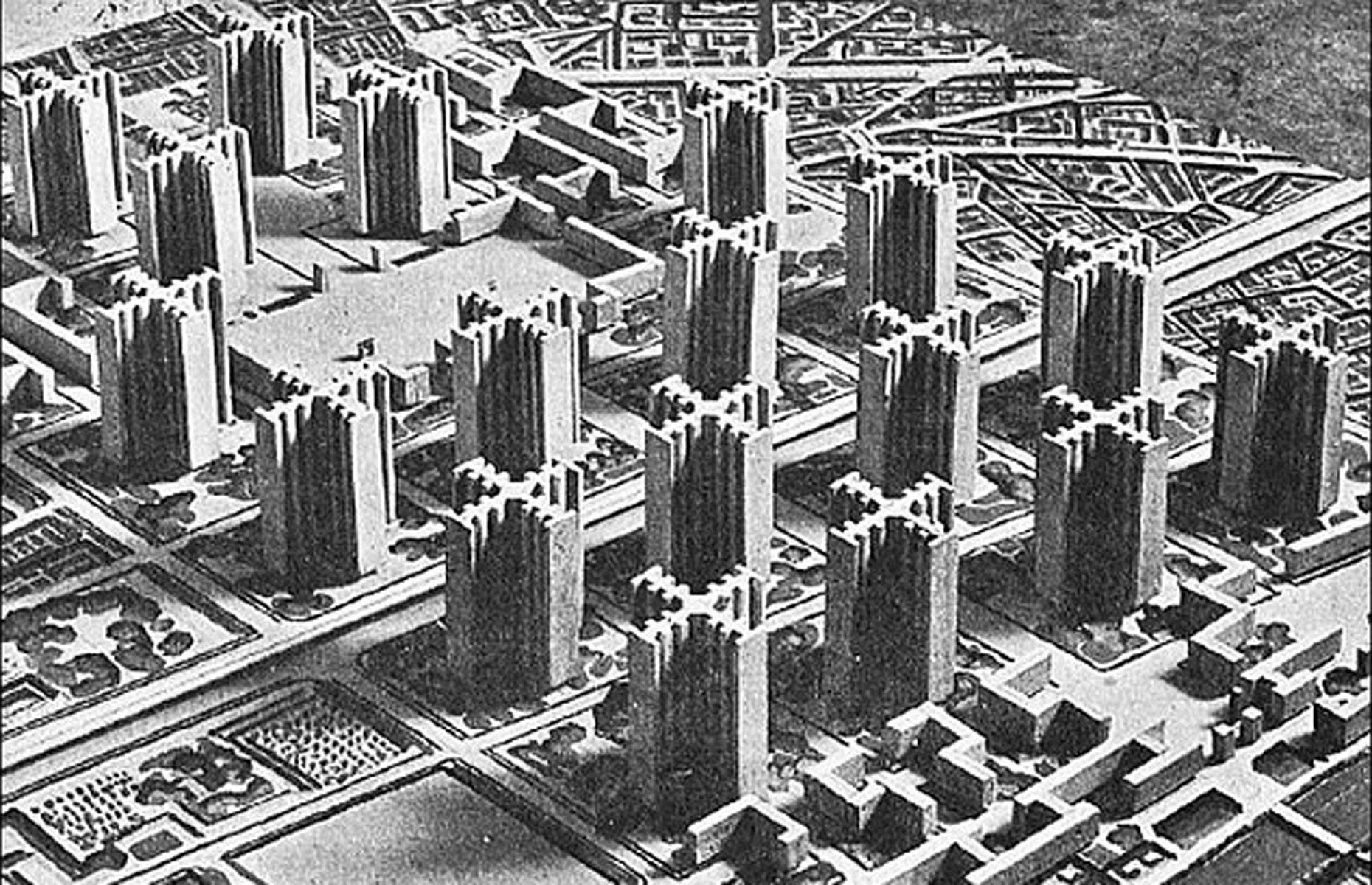
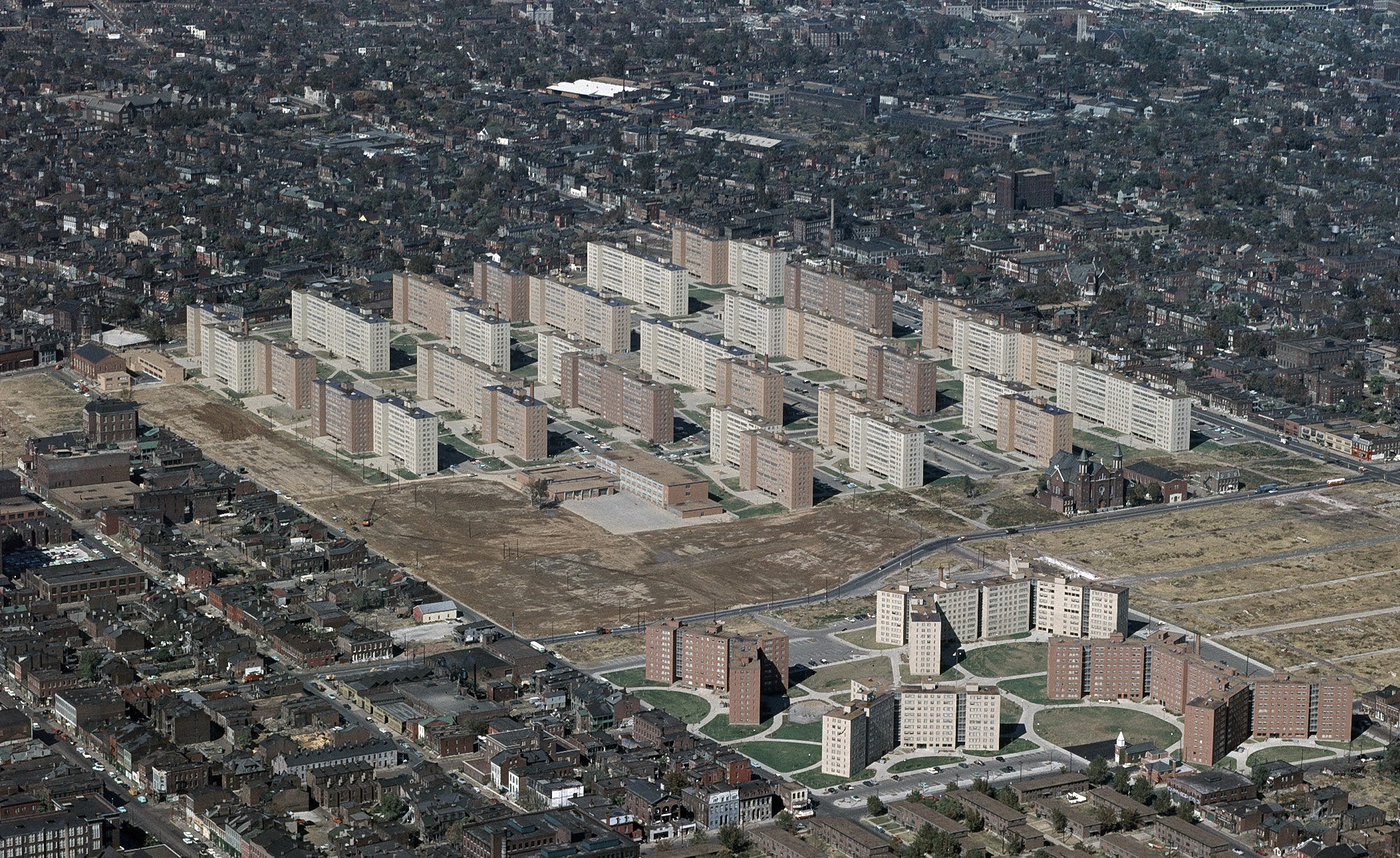
The “Projects” built in this model generally failed, most spectacularly in the Pruitt-Igoe project in St. Louis, which was demolished only 18 years after it was first built. The land where it sat remains vacant today.
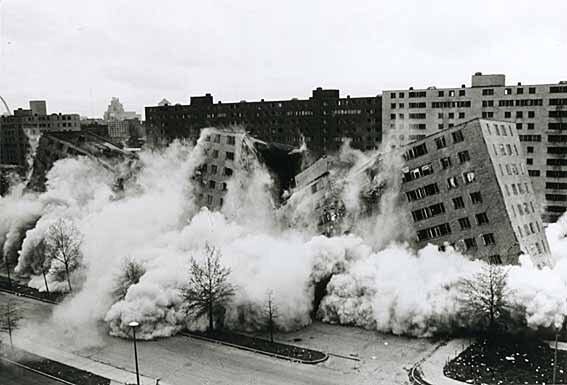
This destructive discontinuity provoked broad backlash against the authoritarian force that was necessary to implement it, and the associated mid-century notion of technocratic “progress.”
Like all aesthetics, the mid-century futurist aesthetic reflects the values of the High Modernists who created it. It embodies a longing for space, light, and cleanliness; freedom from a recent past of war and chaos. It represents values of progress through technology, top-down order, and expert design. It emphasizes then-new construction techniques, using concrete and steel to defy the constraints of carpentry or masonry, symbolically declaring that the limits of the material world will be overcome.


We imagined the Magic Highway of Tomorrow. We got Stroads
The mid-century aesthetic faded away when the ideas it stood for were specifically rejected. In the 1960s and 70s, activists pushed back against top-down control and demanded public participation. Thinkers like Jane Jacobs and Christopher Alexandercelebrated the learned wisdom of traditional buildings and neighborhoods while shredding the failures of the high-modernist experts. And iconic books like the Population Bomb and Limits to Growth proclaimed that the limits of the material world could not be overcome.
I said above that today’s negative view of progress reflects the current generation’s distrust in institutions, our anxiety over environmental quality and existential risks, and our limited hope that our fundamental problems can be solved. We must understand: those fears stem directly from the failed attempt by the top-down mid-century high modernists to reinvent the world. That’s what killed the spirit of progress. Today’s progress movement should be verycareful about drawing too much from their work.
Discovering a new aesthetic
The progress movement is built around one primary idea:
We need a new philosophy of progress for the 21st century. One that teaches people not to take the modern world for granted. One that acknowledges the problems of progress, confronts them directly, and offers solutions. And one that holds up a positive vision of the future.
Of the popular aesthetics of the future that exist today, it’s clear that Solarpunk is the closest to a contemporary aesthetic of progress. Solarpunk directly addresses today’s fears and struggles, and imagines solutions that resonate with today’s values.
But, unfortunately, Solarpunk shares a flaw with mid-century futurism: it’s too far removed from the present. Solarpunk rarely engages with what happened to the world we live in now. Where are the partial retrofits, the scaffolding, or the old strip malls? What happened to our downtowns, our industrial parks, or our gated subdivisions? Dreaming from a blank slate makes for engaging fantasy, but it’s a trap.
The progress movement should learn from and be influenced by the social and environmental optimism of Solarpunk. We can also take some inspiration from the technological optimism of mid-century art, even as a movement that acknowledges the problems of progress must also confront the failures of mid-century futurism and avoid repeating them.
But I conclude that the progress movement will ultimately need to discover a new aesthetic of progress for the 21st century; one that learns from the mistakes of the past, speaks to the hopes and fears of the present, and presents a credible vision of a genuinely better future we can achieve without erasing the past.
And discover is the right word. We’ll have to decide what we believe in, beyond simple optimism, or openness to technology and change. We’ll need to find the shared values that unite us. Then the aesthetic of progress will emerge, over time, from the work of practitioners aligned to those values.
Thank you to many friends from the Roots of Progress who provided feedback as I worked on this essay, including Benedict Springbett, Jeff Fong, Hiya Jain, and Mike Riggs, and special thanks to Pam Burleson who patiently discussed at least a dozen variations to help me figure out what I was trying to say.
I think you nailed the problem with Solarpunk, which is that it feels unattainable. Even as an optimist, my predominant feeling looking at that imagery is "wistful". As in, I would love that but don't actually think it's possible. And the progress movement has to make people think the better future is possible. Solarpunk is the Futurists' Shire.
Great piece/ it’s fun to fantasize about futuristic looking places, I get it. I’m a sci fi fan, too. It can also be kind of dumb and pointless in the way a lot of Utopianism is. 80 or 90% of what will exist 30 years from now is already built. And there’s a few thousand years of human traditions of building that deserve to continue. We’d be beyond arrogant to throw that all away.