
City Life comes from Connectedness
“Walkability” is a red herring

How do you think about your daily routine?
You probably think of it as a sequence of events, with an emphasis on the activities you do, and specifically the places where those happen. Get ready for the day. Take the kids to school. Stop for coffee. Go to work. Pick up the kids. Take them to the playground. Go home.
Everyone’s routine is different, but the mental picture is similar. If you were to draw it, to sketch out your day, it might look something like this:
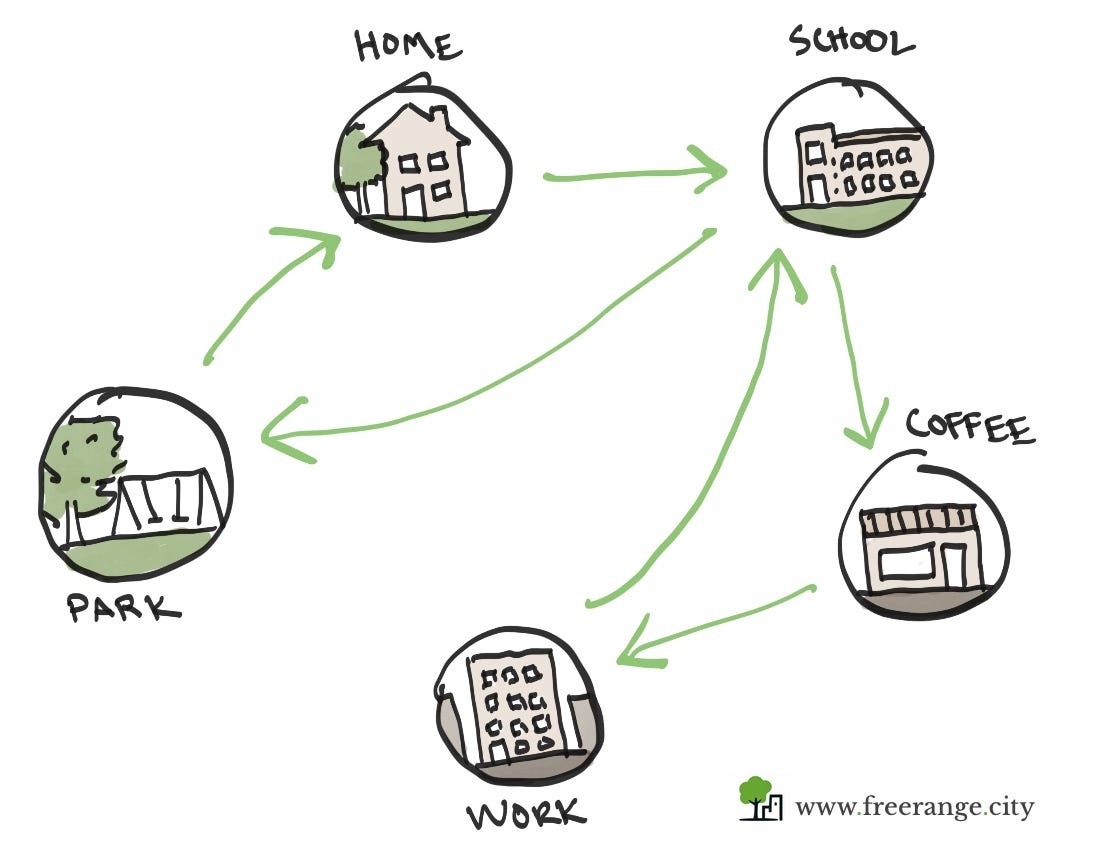
This is a very normal way to picture your day.
In my last post, I asked, “What is City Life?” I concluded that “City Life” is an experience that some people have had, some people haven’t.1 The people who have had it can’t explain it to the people who haven’t. That resonated with a lot of people.
In that article, I pointed out that when people try to describe “City Life,” they often end up talking about “walkability.”
The one thing people tend to land on is “walkability,” because it’s the closest thing we have to a concrete concept that is always present in all places that have “City Life” and rarely present elsewhere. But even that is fading, as more suburban developments try to offer “walkability,” which manifests as wider sidewalks, or parks with “trails”, or open-air shopping centers. I’ve had suburbanite family members show me things like this and say they are “walkable,” and I can only shrug because, no, that’s not what “walkable” means to me, but there’s no point debating that because we have no shared frame of reference to understand each other.
I feel pretty strongly that centering on “walkability” is a mistake. I’ve written about this before (See:“When Urbanists say ‘urban’” for photos!), but I’ll put it differently today: walkability is not the cause of “City Life,” it’s an effect.
The cause is something deeper. Something we don’t have a well-established term for. I think we should call it connectedness.2
To understand this, I want you to consider two different kinds of neighborhoods.
First, the Austin suburbs, where I grew up. If you made your mind map more physically accurate, it would look something like this.
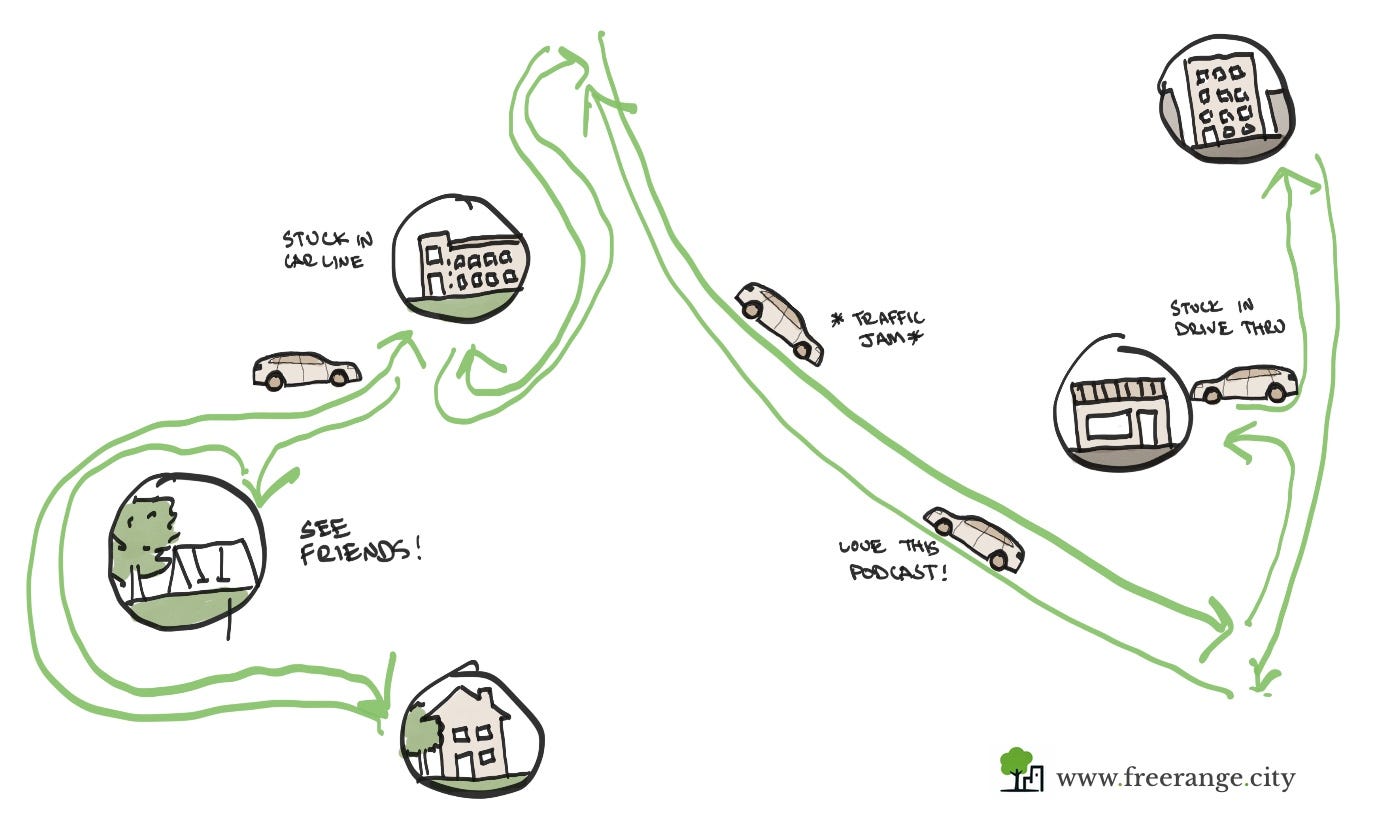
What connects every dot is a trip in the car. Note: driving is fine! But when you’re traveling on those lines, you’re spending your time here:
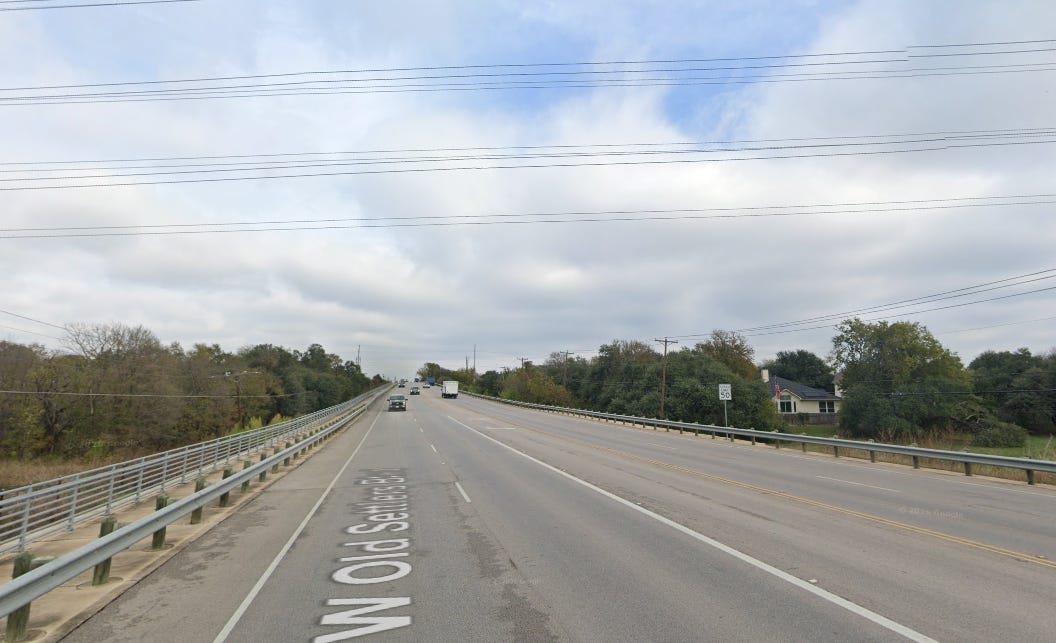
Actually, here:
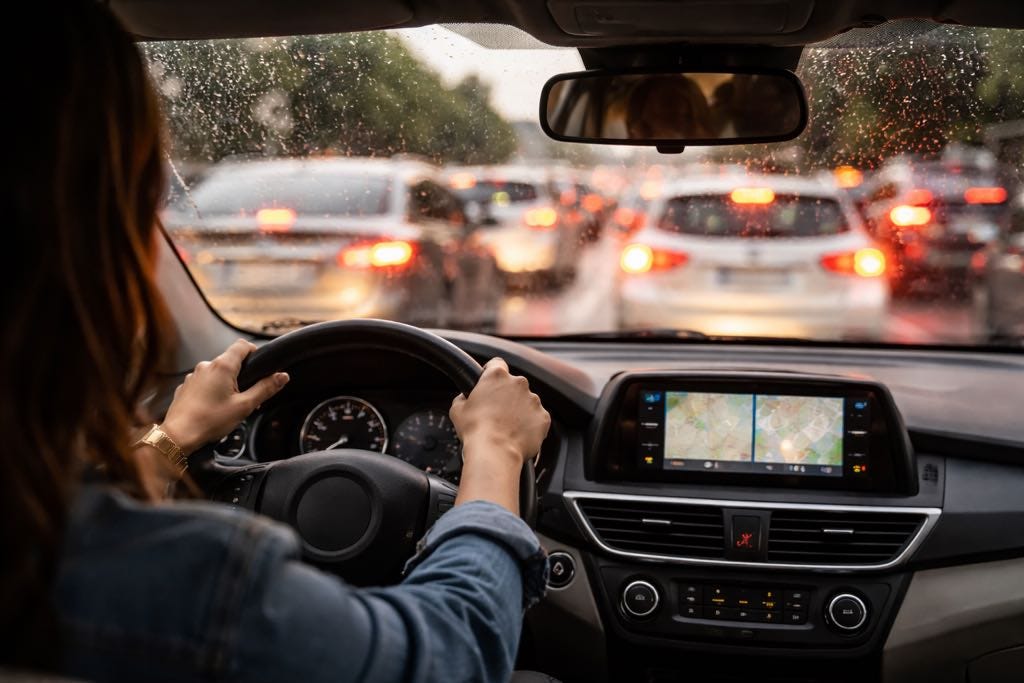
You’re a packet on the internet, flowing through the network. Or water in a pipe. You’re spending your time in liminal space. What you experience is the inside of your car and a podcast.
Any social interaction you have with other people in this context is a problem. It would be better for you if there was nobody else using the road. You could go as fast as you wanted and never stop, which would be awesome!
Second, let’s consider the “streetcar suburb” of Denver, where I live now. A more physically accurate depiction of a day would look like this:
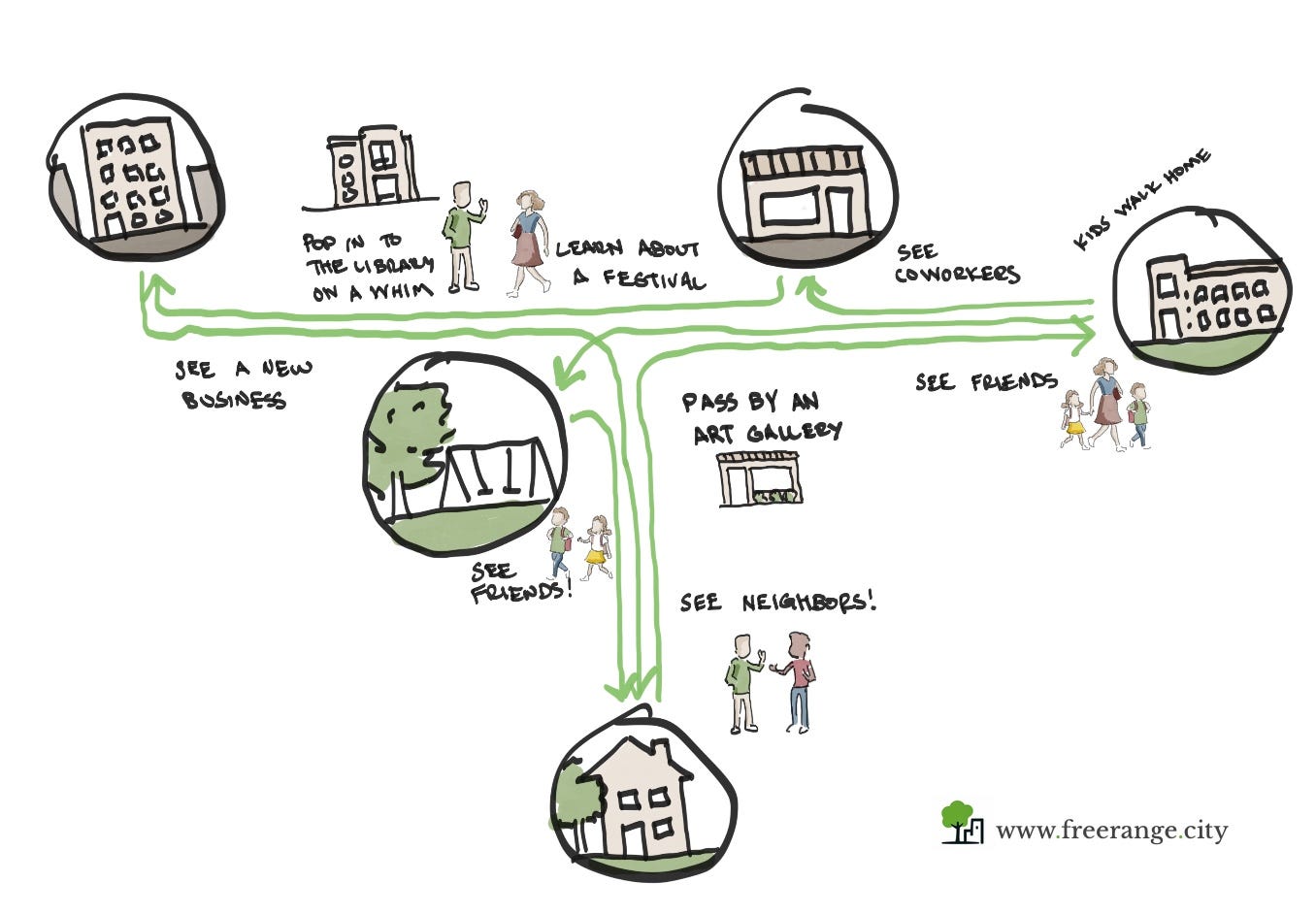
The streets between every dot are public, social space. I can drive through. I can bike through. I can, and usually do, walk through.
When I walk, interesting things tend to happen. I bump into friends and neighbors. I see that guy who rides a giant tricycle, which, I think is kind of weird, but, that’s fine. I pass by shops that I like, and see flyers in the window saying they have an event this weekend. When I’m traveling on those lines I’m spending time here:
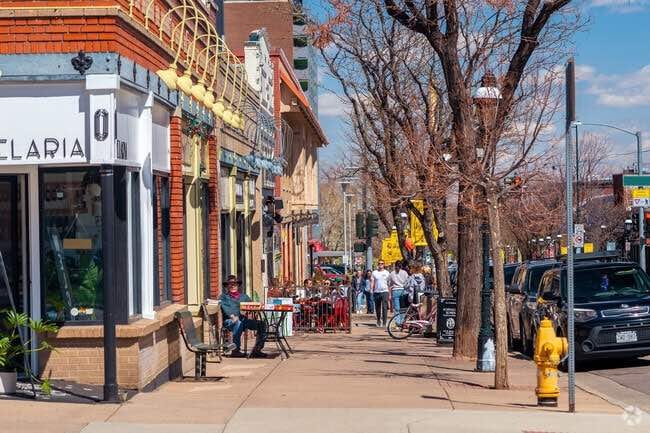
I don’t have to stop and experience the space in between the places I’m going, but I can. They are all connected. At every point in the journey, I’m passing by someone’s front yard, or patio, or storefront, or lobby, etc.
The mode of travel is not the cause. Having multiple nice options to pick from is an effect!
There’s another nice effect of connectedness. The lines on my map up being different because my kids can get themselves to and from school on their own, which is fun for them and saves me time.
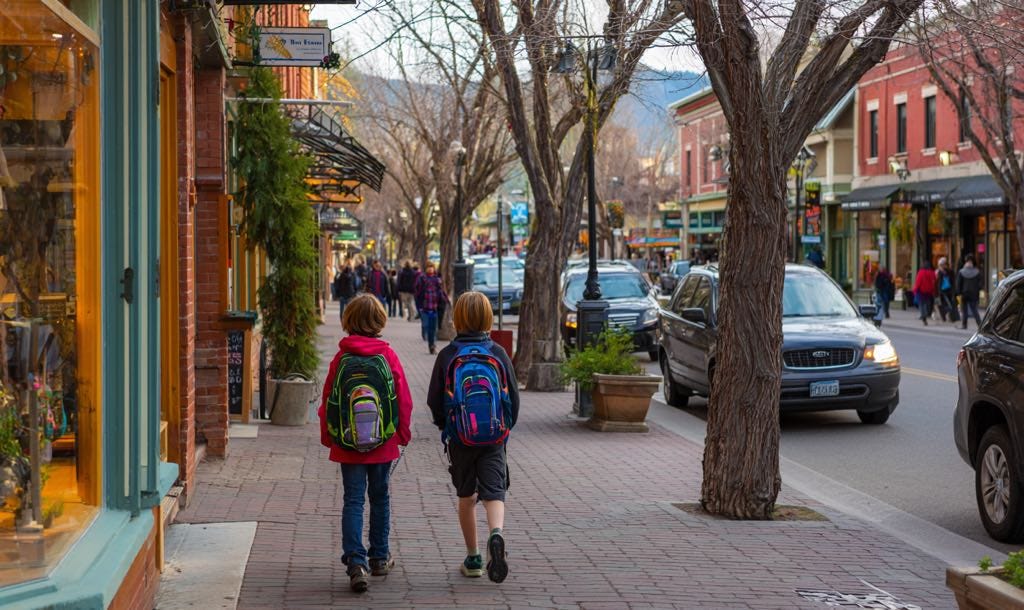
When they walk home from school, the kids’ path is often like this: look in the shop windows, stop and buy a donut using their allowance money, stop and play on the playground with some other friends from school, get home in time for dinner.
From our house to the school there’s continuous, seamless, connected social space. It’s where we know our neighbors, where people hangout, and where most of the business of the neighborhood happens.
To bring this illustration full circle, and emphasize that the issue is not the literal ability to walk, I want to go back to the suburbs I’m from. My parents live closer to several convenience stores than I live to the school or church we regularly walk to. But this is the space in between:
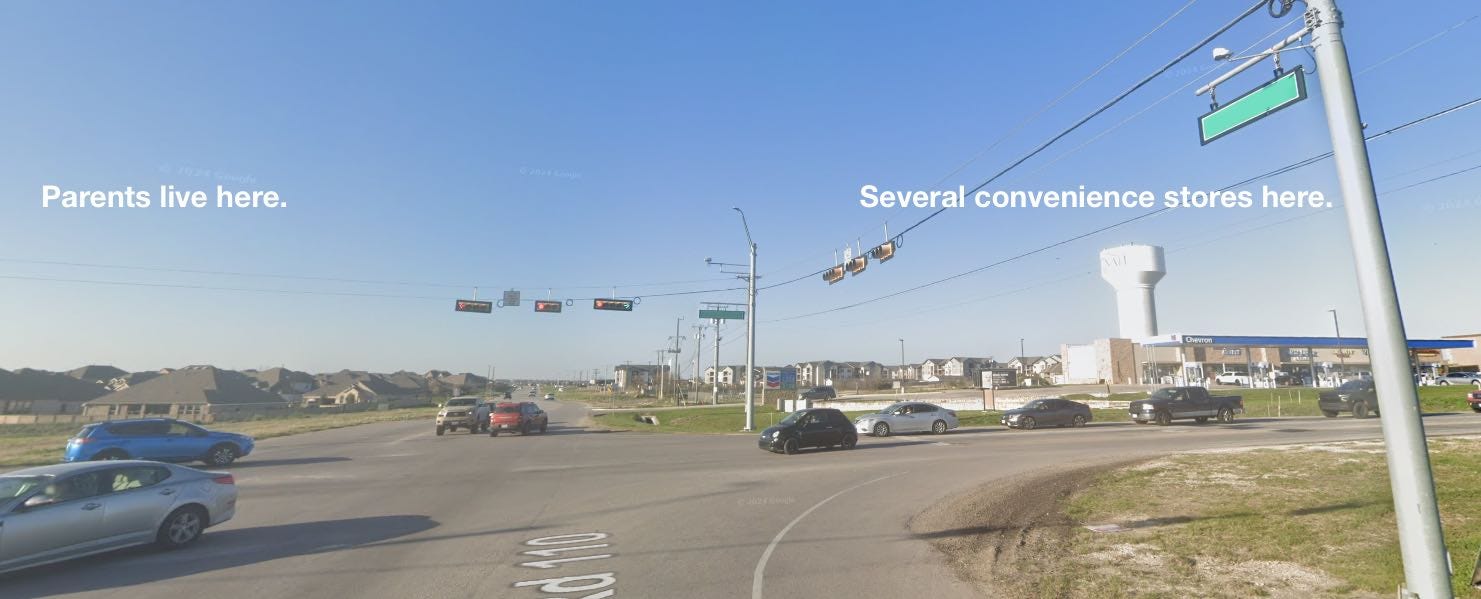
If they were to walk, it would be considered weird and anti-social (not to mention dangerous!). If a neighbor saw them, there’s a good chance they’d pull over and ask if they were okay. They’d offer a ride. You are not meant to be outside in the infrastructure. That’s liminal space, not fit for human consumption. If you’re out there something has gone horribly wrong and/or you must be desperately poor.
In America, almost everything we’ve built since the mid-century is disconnected.
Round Rock is an archipelago. Even when you’re close enough to see the other islands, you don’t swim those shark-infested waters. You take your boat. You’re meant to take your boat. Swimming between the islands would be crazy. And no matter how nice each island is, no matter how internally interesting or walkable, it’s still not connected to the rest. (See also, most “New Urbanism” is just a theme park.)
The connected, mainland places that remain have something we really struggle to put into words. I’ve called it “City Life.” Or as I said in my last post, “the cultural experience of living inside of an urban fabric where all the parts of your life, including your home, are part of a larger whole, that you belong to, and are immersed in every time you step outside.” It’s something experiential, that people who lack the experience can’t really understand (through no fault of their own!).
It’s not walkability, although walkability is an effect. It’s a kind of social fabric that makes the community stronger, and offers more freedom and independence for children and the elderly. It’s valuable. And to the best of our ability, we should all be working to bring it back.
Note that “City Life” is not limited to “big cities.” Many small towns have it, and many big cities lack it!
Note that I’ve also written about connectedness before, in “A Taxonomy of Place,” specifically illustrating the importance of connected street networks.
Your point here is an important one, that connectedness is the underlying boon and walkability an effect is spot on. Walkability has become the catchphrase for determining good urbanism, something tangible that people can experience. As you say, it is certainly an element within the design. What’s left out of that talking point, though, is the recognition that when the various elements are well-assembled, a whole emerges that is greater than the sum of its parts – and therein lies the difference between urbanism and a collection of things – a place. Suburban environments have all of the same elements. What they lack is a coherent assemblage. There is no “there” there. Thanks for reorienting this conversation from one talking point to the bigger issue.
I’d like to push back gently on two points you made. First, this isn’t a new understanding, but our conversations do need to be re-centered. Many people have been circling this same idea for decades: urbanism isn’t a checklist, it’s an emergent condition. We shift the language (walkability, placemaking), but the underlying principle is consistent. Spatial definition + proximity + permeability = social life. I offer a couple of examples of how long this has been known, even if we have stopped talking in this way. James Howard Kuntsler’s 2004 TED talk. I’m sure you’re familiar with his writings that first gave voice to the New Urbanist movement. In this, he reminds us that buildings are the connective tissue that defines space. It is our ability to define space that allows this “place” to emerge. These places permit for what Jan Gehl called the “life between buildings.” Leon Krier taught us that public spaces need to be formative, not residual, as evidenced in your examples of public trails along waterfronts vs Main St. Those trails can be pleasant, even beautiful, but are typically linear, optional, and episodic. They don’t structure everyday life in a way that fosters connection. Krier’s distinction gets at the same subtle thing you’re pointing to. Places we're required to pass through (squares, main streets, markets), generate unplanned encounters. Places that we choose to visit (trails, parks at the edge) tend to filter them. That’s the difference between a collective awareness, or shared sense that we’re in this together, and recreational coexistence. Gehl’s “Life between buildings” depends on friction, not just amenity. As Kunstler states at the end of his TED talk, these public spaces may actually be necessary to foster some sense of the common good. The second example (easily googled) is a 1989 talk by Andres Duany that details all this beautifully. This notion has always been at the heart of New Urbanism, or traditional neighborhood design.
Which brings me to my second pushback: New Urbanist places are theme parks. I think that’s unfair, a bit of a lazy shorthand, though I grant you an important downside. I see two problems that inhibit New Urbanist developments from becoming more. One, they are highly sought after because they're so pleasant to be in, and two, they comprise a small percentage of the built environment. So, even when designed for mixed incomes, the prices quickly soar and become unaffordable for many. That’s not a downfall of the design; it’s a downfall of the number of well-designed places available. Also, they are often encapsulated as they bump up against the zoning and preexisting, poorly planned land use that abuts them. In fairness, so do Charleston, Savanah, and New Orleans. Their cores are world-class urbanism, but once outside of that core, they devolve into suburban anywhere. I agree that places need to be able to iterate over time and grow, to an extent. I also agree with Leon Krier’s idea of duplication rather than hypertrophy or overexpansion.
Where your criticism of New Urbanism rings true is that, unlike Savanah or Charleston, the New Urbanist developments do seem to arrive too complete, too resolved, overdetermined. Those older cities feel authentic not just because of their design, but because they embody layers of time, conflict, adaptation, and even inconsistency. That messiness (love that description, Kevin Klinkenberg) isn’t incidental; it’s constitutive. However, it’s not their fault that we’ve only gotten back to building quality habitats in the past 40 years. Human scale seems to be another essential element in creating that sense that connection. The hope is that when people have the opportunity to experience good urbanism, they will demand changes within their own habitats so that well-built places can continue to grow and evolve.
It strikes me that these two constraints of scarcity and encapsulation point to something structural. Scarcity: demand coupled with regulatory friction. Encapsulation: a product of the discontinuity of underlying systems (zoning, financing, street hierarchies). A New Urbanist development next to conventional suburbia isn't just visualy different. It operates on a different logic, and the seam between them is often hostile.
The last attachment here is a brilliant piece of writing by Anthony Eagan, a review of Jorge Almazan’s book Emergent Tokyo. In it, he compares St. Petersburg’s top-down planning with the organic, incremental iterations of ever-evolving Tokyo. Through the lens of complexity, Eagan suggests that maybe the best approach to good design is the framework within which all living systems exist; a scaffolding of structure that remains open and adaptive to change. Suburbia is chaos and noise, unable to cohere into something distinct. Top-down, solidified planning is rigid and eventually collapses. The trick is to find that flow between those two banks.
Thanks for your work. I enjoy your essays.
https://www.city-journal.org/article/liminal-urbanism
Reminds me of this Vonnegut quote about buying an envelope. He references computers but it works equally well about cars:
“I once told my wife I was going out to buy an envelope:
“Oh,” she said, “well, you’re not a poor man. You know, why don’t you go online and buy a hundred envelopes and put them in the closet?” And so I pretended not to hear her. And went out to get an envelope because I have a hell of a good time in the process of buying one envelope.
I meet a lot of people. And see some great looking babies. And a fire engine goes by. And I give them the thumbs up. And I’ll ask a woman what kind of dog that is. And, and I don’t know.
The moral of the story is – we’re here on Earth to fart around.
Of course, the computers will do us out of that. But what the computer people don’t realise, or they don’t care, is we’re dancing animals. You know, we love to move around. And it’s like we’re not supposed to dance at all anymore.
Let’s all get up and move around a bit right now…or at least dance.”