
Cities, Progress, and Parenting
Reframing, and renaming, this newsletter

I’m changing the name of my newsletter from “The Post-Suburban Future” to “Free Range City.”
If you follow via email or the Substack app, you don’t need to do anything to continue following. If you want to look up the newsletter on the web, you can now find it at www.freerange.city.
Today’s post covers why I made this change, and how what I’m writing about will broaden a bit.
When I started this newsletter in April 2024 I only had one goal: start writing consistently again.
My experience is that writing is a powerful way to open doors. From 2008-2012 I blogged regularly, and that writing helped me connect with local advocates and form the Houston Chapter of the Congress for the New Urbanism. That in turn connected me to the CNU Next-Gen, where I met Chuck Marohn and joined his work to transform Strong Towns from a blog to a national movement.
Writing increases your “surface area for luck,” and I’ve reached a stage of life where I’d like to do that again. But writing isn’t an easy habit to build. It takes a long time to even figure out what you want to say, let alone to wrangle your thoughts into a coherent essay.
So my only goal was to write at least once a month. I did nothing to promote the newsletter; actually, I knew that I would inevitably write some low quality essays in the process of rebuilding my mental muscle, and I embraced not having an audience as a liberating opportunity to just force myself to publish something. And I didn’t think very hard about what to call it, or how to describe it.
Now that I’m ~18 months in, I’ve mostly gotten my writing muscle back. Doors have started opening doors again. I’ve been meeting other writers through the community on Substack, and I had the chance to participate in the Roots of Progress writing fellowship, which connected me to the Progress community. About 1,500 people have subscribed to follow along (wow!). But as this newsletter has gotten established, I’ve realized that the name I started with doesn’t fit very well.
Initially I figured I’d mostly write about what comes after today’s conventional suburban development pattern, so I called the newsletter “The Post-Suburban Future.” Then, I couple months ago I found myself thinking about the jargon we “urbanists” use, and how it can cause us to talk past each other.
Unfortunately, for many people “suburban” and “urban” mean roughly “good” and “bad.” Which one you think is “good” and “bad” have a lot to do with your age, where you live, and your personal politics. But because the majority of Americans live in the suburbs, more people think of “urban” as “bad” and “suburban” as “good.”
While it’s linguistically difficult, I concluded that it would be better to minimize use of the words “urban” and “suburban.” But I’m violating that rule right in the title of my newsletter🤦♂️. Since then I’ve been thinking about what I might like to call this instead.
I wrote a personal essay a few weeks back, “The Free Range City,” and the title has stuck with me. I think it’s a better description of what I care about.
What personally animates me the most is freedom. That includes freedom to build housing, and freedom to create more beautiful places than today’s rules allow. But most all, it means freedom for families. I want my kids to live a high-autonomy life, to be able to explore the world around them safely on foot.
Free-Ranging has become a widely known concept in agriculture: basically what you’d think farming is like, with animals roaming a pasture instead of being confined to cages indoors. We intuitively grasp why it’s more humane for animals to graze outside — yet fail to notice how we’ve placed ourselves in the equivalent of industrial farming environments.
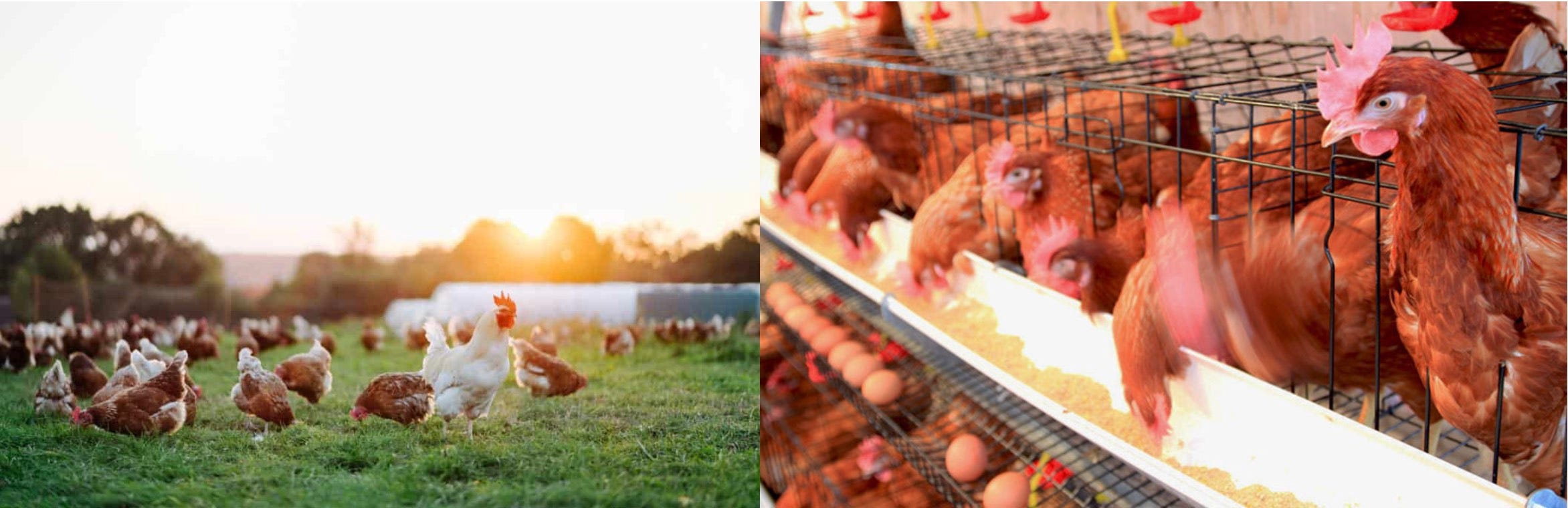
Most Americans live inside self-contained boxes, which they leave by going into their airlock, boarding their transporter pod, then traveling through uninhabitable infrastructure to get to another self-contained box. We live more like packets on the internet than people in a place. We don’t routinely experience the most basic human activity, walking around and exploring the world around us, serendipitously bumping into friends and neighbors along the way. It isn’t good for us!
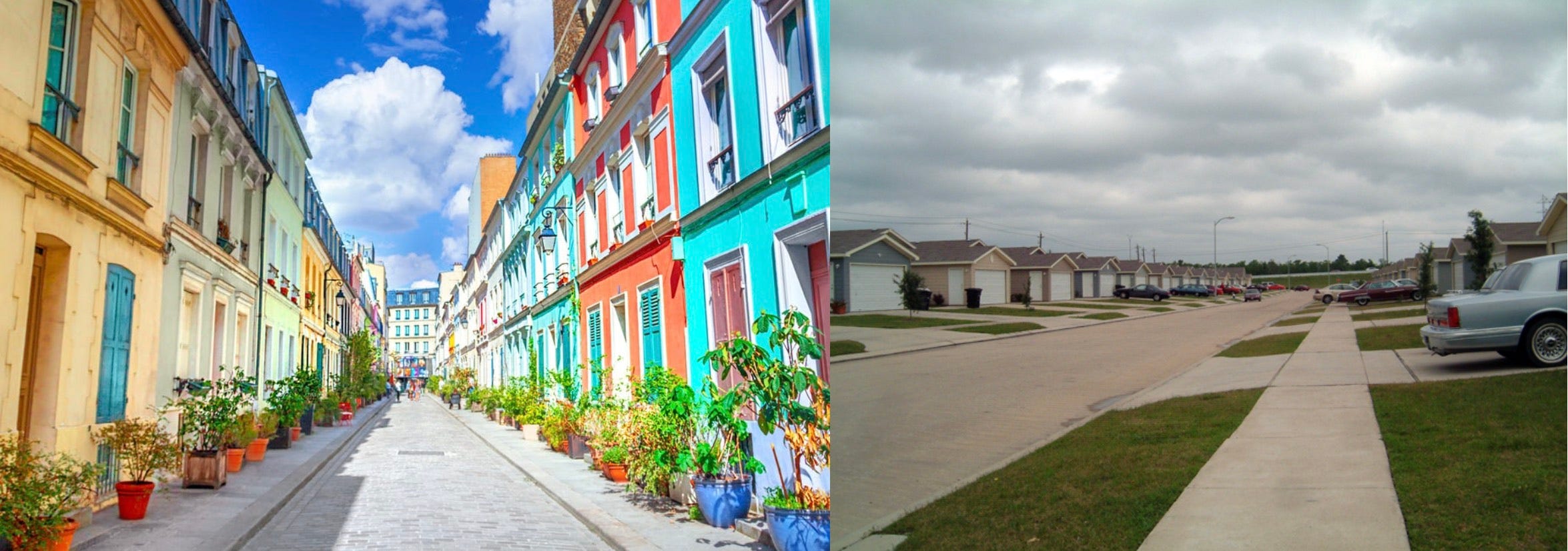
This change in the way we live has been especially limiting for children. The decline in childrens’ autonomy was most poignantly captured in an article by David Derbyshire, which featured this map:
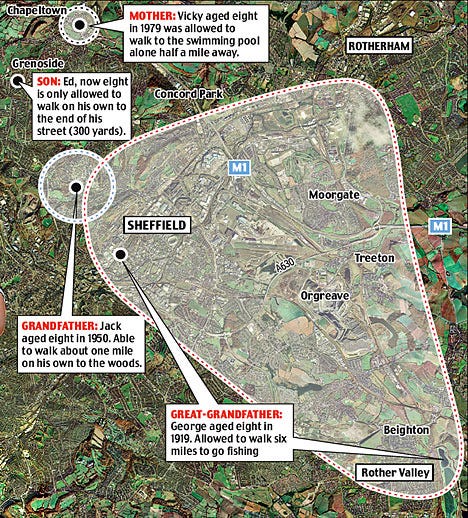
Over the last few generations our children’s freedom to roam and explore has shrunk to nearly nothing. It isn’t good for them!
Kids should be free to go to their friends houses, to play at the park, to walk to school, to live in their neighborhood, without needing an adult to drive them everywhere.
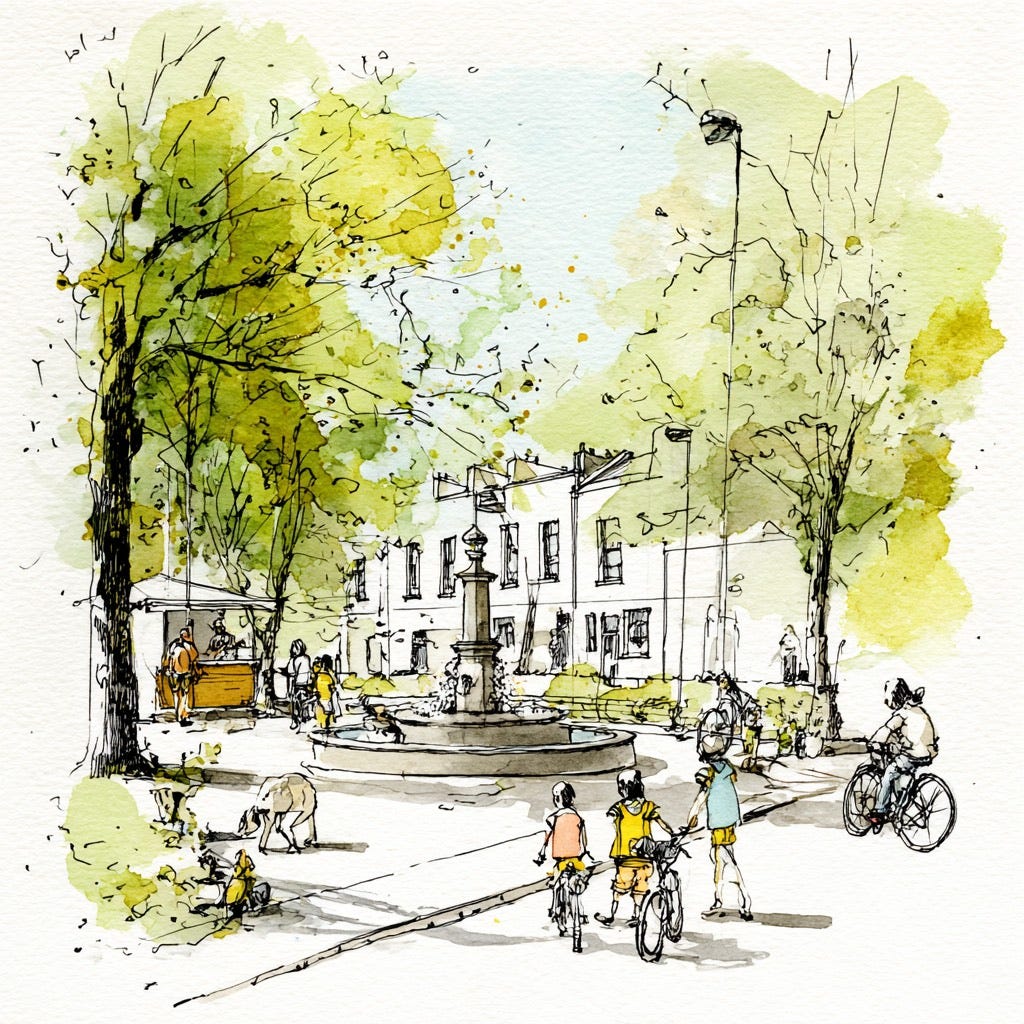
My passion is to help us rediscover and rebuild our natural human habitat: villages, towns, and cities, that people can roam through and between, without depending on mechanical intervention. Cars, busses, trains, etc. are all wonderful inventions, and of course we should continue to use them. Micromobility and autonomy will make these technologies better than ever! But mobility machines are tools we should use when we need them, not artificial life support we can’t function without.
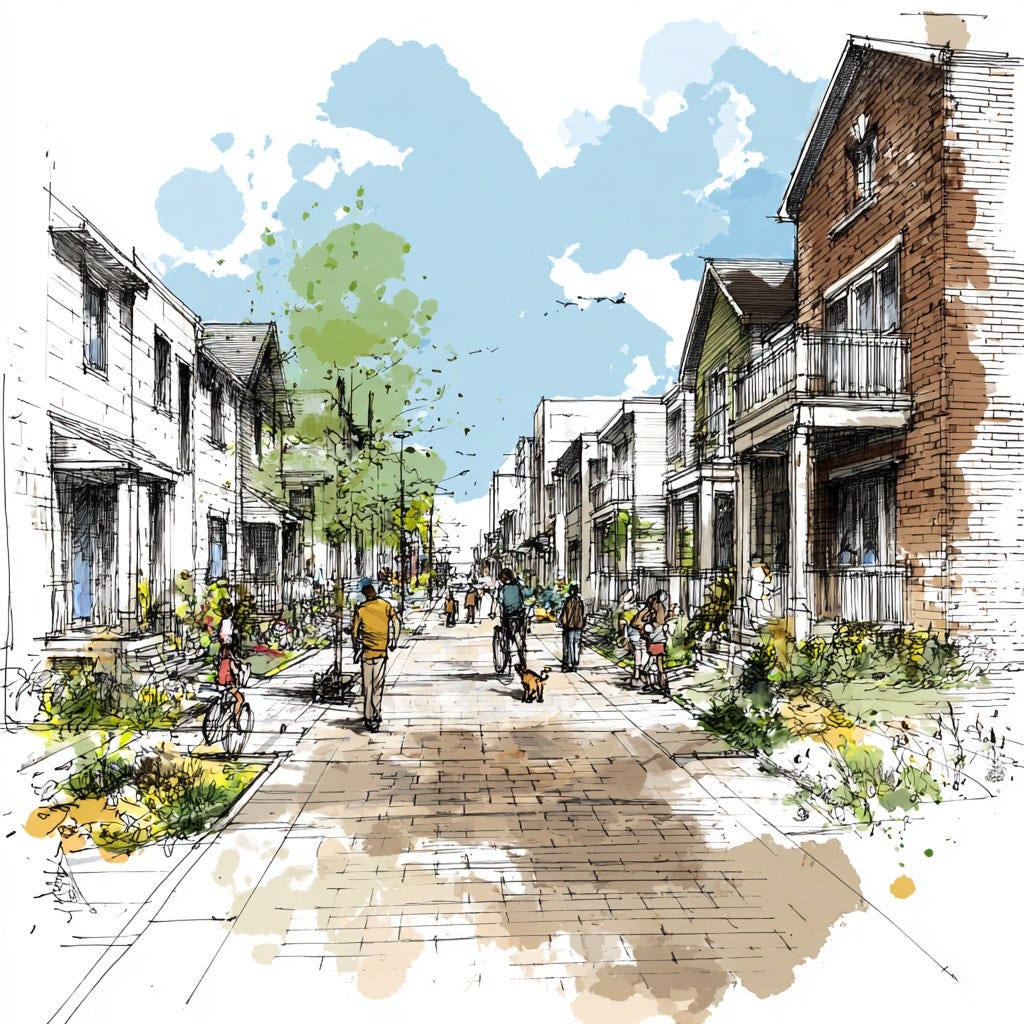
There’s a final element of “Free Range” that I like as a more thoughtful title for this newsletter. While I’ll mostly continue writing about the past, present, and future of cities, I also want to incorporate some thoughts on parenting and family life, and on societal progress and the Progress movement. And I like the idea of the newsletter having a broader, less constrained title to match.
So, today the newsletter gets a new name, and a slightly broadened theme. Welcome to Free Range City!
Much better name.
I think you might find this article quite interesting given the shift
https://stratechery.com/2025/robotaxis-and-suburbia/
You are blending of my two passions - livable places and independent kids! I have a financing question - I've heard that developers trying to build the right thing have a big financing barrier, because the usual real estate lenders don't like new things and can't model the upside of this kind of property. Is there a loan fund out there that gets it? In regenerative agriculture, there's Steward (https://gosteward.com/) - what's the equivalent?